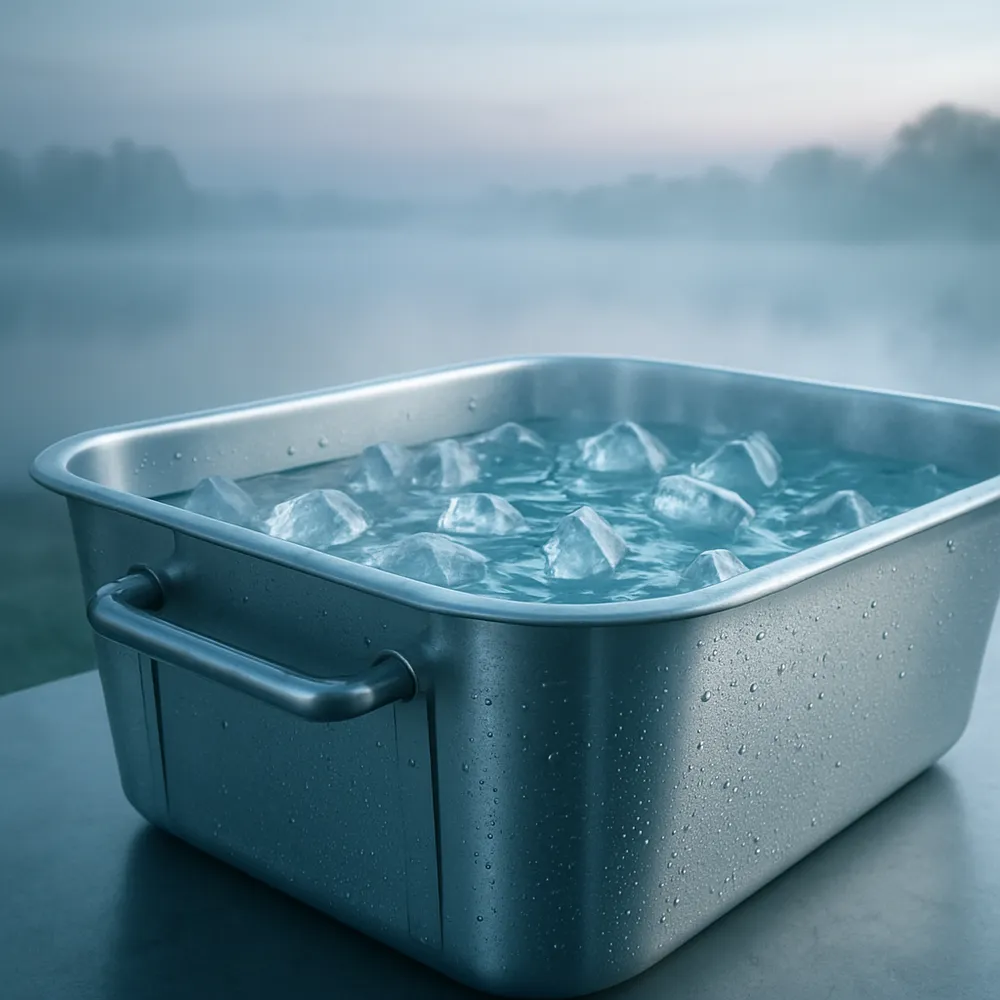
Cold Plunge Tub, 110 Gal
Yes - if you accept it's an insulated ice bath, not a chiller. This 110-gallon insulated tub holds cold water and ice well, fits athletes over 6 feet, and accepts an external chiller later. Without one, you're managing ice every session. Solid value for protocol-driven recovery; not plug-and-play.
Rate this pick
Our own community ratings — from confirmed Amazonia readers, never Amazon. Yours helps the next person decide, and steers what we feature next.
What does the research say about the Cold Plunge Tub?
Every claim below is tied to a source you can open, quoted verbatim — how we research picks.
-
“A significant reduction in stress was observed 12 hours post-CWI”
A 2025 systematic review (11 RCTs, 3,177 participants) found cold-water immersion caused an acute rise in inflammation immediately and 1h after exposure, with a significant drop in stress only at the 12h mark and no consistent mood benefit; gains in sleep quality and overall well-being looked promising but rested on limited, mostly single-session evidence.
Systematic review & meta-analysis, PLOS One · 2025 ↗ -
“Our study shows that CWI can significantly restore the impaired vagal-related HRV indexes observed after supramaximal exercise.”
In a small crossover trial of ten cyclists, 5 minutes of cold-water immersion at 14C accelerated parasympathetic (vagal) reactivation after supramaximal exercise, restoring heart-rate-variability indexes faster than passive recovery.
Crossover RCT, Am. J. Physiol. Heart Circ. Physiol. · 2009 ↗
Educational summary of the research — not medical or veterinary advice. Evidence strength varies and individual results differ; talk to a qualified professional before changing your (or your pet's) health routine.
How does the Cold Plunge Tub compare?
| Inflatable tub (this) | Chiller plunge | Ice barrel | |
|---|---|---|---|
| Cold source | Ice (chiller add-on) | Built-in chiller, set & forget | Ice |
| Upfront cost | Low | High ($3k-$10k+) | Low-medium |
| Temp consistency | Variable, ice-dependent | Precise, repeatable | Variable, ice-dependent |
| Portability | Packs down, very portable | Heavy, fixed install | Rigid, bulky |
| Ongoing effort | High (managing ice) | Low | High (managing ice) |
Buy it if
- Endurance and team-sport athletes prioritizing between-session fatigue recovery
- Budget-conscious biohackers who'll add a chiller later via the compatible fitting
- People who need a tub that packs down and stores or travels
- Anyone who'll actually run a thermometer-tracked protocol rather than wing it
Skip it if
- Lifters in a dedicated hypertrophy phase plunging right after training
- Anyone wanting plug-and-play, set-temperature cold without managing ice
- Those who want a permanent, rigid, install-once fixture
Is the Cold Plunge Tub worth it?
As an insulated ice bath, this is a smart, portable entry point - roomy for tall users, ready for a chiller when you want one. Be honest with yourself: without that chiller, you're buying ice and managing temperature by hand. Dial in the dose, keep cold away from hypertrophy work, and it earns its place.
Check price on Amazon Live price & reviews on AmazonQuestions, answered
- Does it cool the water by itself?
- No. As sold it's an insulated tub - you cool it with ice. It's threaded for an external chiller, so you can add one later for consistent, ice-free temperatures, but that's a separate purchase and cost.
- How cold and how long should I plunge?
- Evidence for soreness points to 10-15 minutes around 11-15C; for blunting muscle-damage markers, 5-10C. Cold exposure is a stressor - more isn't better. Use a thermometer and don't chase colder-is-tougher. Source Front. Physiol. network meta-analysis, 55 RCTs (2025) ↗
- Will it hurt my muscle-building?
- Possibly, if used right after lifting. Roberts et al. (2015) found post-resistance-training cold immersion blunted hypertrophy signalling. On hypertrophy blocks, separate plunges from training or skip cold on hard lifting days. Source Roberts et al., J. Physiol. (2015) ↗
- Inflatable cold plunge tub or a chiller plunge - which should I get?
- The inflatable tub is low-cost and very portable, but you cool it with ice, so temperature is variable and it takes real effort every session. A chiller plunge has a built-in chiller for precise, set-and-forget temperatures with low ongoing effort - but it runs $3k-$10k+ and is a heavy, fixed install. Get the inflatable tub to prove the habit cheaply (and add a chiller later via the compatible fitting); the chiller plunge if you want plug-and-plunge consistency.
- Does cold plunging actually improve mood and recovery?
- The evidence is mixed and mostly early. A 2025 systematic review (11 RCTs, 3,177 participants) found cold-water immersion caused an acute rise in inflammation right after exposure, that 'a significant reduction in stress was observed 12 hours post-CWI,' and no consistent mood benefit - with sleep and well-being gains promising but resting on limited, mostly single-session evidence. Keep expectations grounded. Source Systematic review & meta-analysis, PLOS One ↗